

A Wood Between Wars - Winnie-the-Pooh
The other day, a student asked me to draw a teddy bear. I make “awards” for my Yeshiva boys every day. Drawings to showcase something I’m proud of them for! So I drew a bear looking for honey, and said, “I see a boy who has been extremely gentle today.” The said child stood up and happily took his black and white sketch to color himself. It made me think of Winnie-the Pooh…
During the horrors of World War II, there was a brilliant, young woman, writing in her diary about a book she recently read and tried to share with friends and family:
“I absolutely had to read Winnie-the-Pooh to someone. When I started in, I saw clearly that no one was interested. And I continued, knowing all the while that I was forcing the others to pay attention, knowing that I was boring them. I got over the revulsion that made me feel I was being boring. But I didn’t understand why the others didn’t know about Winnie-the-Pooh. It’s always the same eternal problem: sharing my enthusiasm with someone else. There is no joy for me other than the joy that I can share with someone else. Now I am deprived of everyone I could share it with….”
It’s not uncommon for a children’s book to not be taken seriously, especially during terrifying times. As the donkey character Eeyore once said:
“This writing business. Pencils and what-not. Over-rated, if you ask me. Silly stuff. Nothing in it."
Who was his diarist finding joy in a piece of classic youth literature…? Helene Berr, journaling on November 13th, 1943, was a French graduate of the Sorbonne. She had started her journal at the age of 21, a year earlier. Berr documented her thoughts on literature and music as well the reality of Nazi anti-Semitic laws. She was also a courageous activist with social work in attempts to save Jewish children from extermination. Winnie-the-Pooh was just one of many books she experienced and shared, but the world A.A. Milne created and E.H. Shepard expressed was a vibrant joy to this young Jewish woman as her community was disappearing in the most destructive of ways. She wrote earlier in that entry, “Yesterday evening, I read Winnie-the-Pooh, which Jeanine Guillaume had brought me. I smiled right down to my heart and even laughed out loud.”
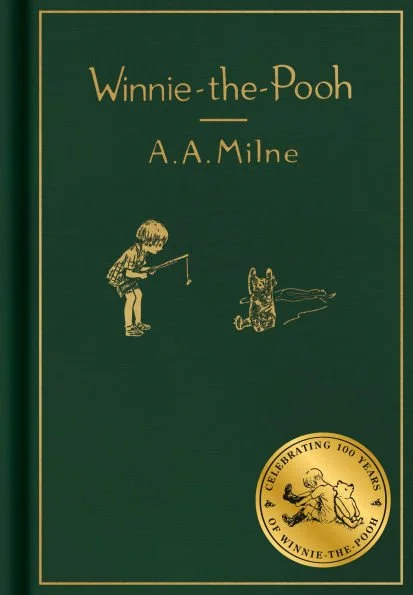
Today I will be exploring the 100 Acre Wood. Not all the tales (nor any of the poems), but the collection of stories published as Winnie-the-Pooh. It was just 100 years ago when that book was released. And it’s my first entry this year (apologies for the absence), this book seems a wonderful choice.
Winnie-the-Pooh envelopes playtime for the main character Christopher Robin - a little boy who explores a wood with his collection of stuffed animal toys. These toys have lives, voices, and unforgettable characteristics that the world has immortalized, commercialized, analyzed, and philosophized then onto now.
The overall plot is a bit sweetly unclear. Is the book is supposed to be Christopher Robin venturing in the woods with his own imaginary friends inside very real toys? Or is it Christopher Robin, safe in his house, listening to his father tell him and his Bear, Winnie-ther-Pooh, an adult-made story that sparks the boy’s imagination in dreamland? I think it can go either way. In the first chapter, Christopher Robin asks the narrator, “Is that the end of the story?” The book continues:
"That's the end of that one. There are others."
"About Pooh and Me?"
"And Piglet and Rabbit and all of you. Don't you remember?"
"I do remember, and then when I try to remember, I forget."
"That day when Pooh and Piglet tried to catch the Heffalump——"
"They didn't catch it, did they?"
"No."
"Pooh couldn't, because he hasn't any brain. Did I catch it?"
"Well, that comes into the story."
Christopher Robin nodded.
"I do remember," he said, "only Pooh doesn't very well, so that's why he likes having it told to him again. Because then it's a real story and not just a remembering."
"That's just how I feel," I said.
And that brings me to a very personal idea…as a teacher, I sadly notice less and less children playing with toys, playing in trees, playing through stories. So either possible plot of Winnie-the-Pooh would be hard for a child to grasp today. In fact, if I presented a playtime with toys or a walk in a woods as options, it would probably confuse my children. Some parents of kids I have watched or taught have even forbidden both activities. Why is that…? Technology as a babysitter? Predators waiting outside? Lack of Imagination? I’m not here to say. But I will tell you in this reflection of my own time with a child who did experience some privileges similar to the character in the Pooh books (NOTE: I’m not referring to the author’s son Christopher Milne, on whom’s playtime the story was based. He was real person which complicated relations to the books and a very separate life to respect. I’m talking only about the fantasy character Christopher Robin created by A.A. Milne).
I have a nephew called David (King David or David King depending who is addressing him). He is 21 now, off exploring school and life. But his childhood beginning was entwined with mine ending. David and I were close his first day onward. From the age of 16, I was a daily part of his life through play and lessons. He loved me unconditionally and taught me the secrets of world.
When I was David’s current age, I had a favorite author - the American novelist Nicole Krauss, the writer of The History of Love. I met her on a college campus after I had devoured her books. She opened my heart to greats of classic and contemporary literature through a Jewish imagination. According to a book by Gyles Brandreth, on the creation of Winnie-the-Pooh, Nicole Krauss said that her English mother shaped her “early world” because the author Lewis Carroll, Kenneth Grahame, and A.A. Milne. She wrote in an article, “none of these writers thought it necessary to protect children from darkness….they guided their readers right toward it. This gives one enormous sense of being respected as a child. Not just of being trusted to handle things as they are, but to be accepted as not entirely good. To be recognized as having darkness within oneself, too. I don’t think I’ve trusted any author since who doesn’t address me with that assumption.” David and I too addressed each other as equals and talked like fellow adventures right into the deep dark woods…
The Piglet lived in a very grand house in the middle of a beech-tree, and the beech-tree was in the middle of the forest, and the Piglet lived in the middle of the house. Next to his house was a piece of broken board which had: "TRESPASSERS W" on it. When Christopher Robin asked the Piglet what it meant, he said it was his grandfather's name, and had been in the family for a long time, Christopher Robin said you couldn't be called Trespassers W, and Piglet said yes, you could, because his grandfather was, and it was short for Trespassers Will, which was short for Trespassers William. And his grandfather had had two names in case he lost one—Trespassers after an uncle, and William after Trespassers.
"I've got two names," said Christopher Robin carelessly.
"Well, there you are, that proves it," said Piglet.
I always laughed at that part. Reading for the first time as an adult, I knew it clearly meant the old sign was to say, “Trespassers Will be Prosecuted”. And I like to think it’s a wink about exploring places off limits with excitement. The first book I ever read to David was Winnie-The-Pooh. It was also the first time I read it (somehow missed it as a child myself). David and I became so enraptured in the stories that we were inspired to go to our back woods daily. We walked for hours, climbing trees like Pooh, bouncing over things like Tigger, braving scary patches like Piglet, having tea parties like Owl, singing songs again like Pooh, and often going on what Christopher Robin called an “Expotition”. It was not common for babies, toddlers, or small children to explore uncleared woods in the early 2000s like it had been for me and generations before. But I wanted David to have that chance despite others looking down on it. David does not really remember these times (despite being shown many photos and videos of his younger self our old back woods). But he smiles to hear of them. He never got hurt despite where we…trespassed. He did not grow up to be explorer or reader like we were throughout our childhoods, but he did grow up to be a kind and smart person, active outside and thoughtful inside, and always open to other people and new understandings.
Winnie-the-Pooh is a world created between the World Wars. It’s author and illustrator were veterans that experienced heavy action on the Western Front. I don’t know whether or not they had shell shock, but I often wonder if these books are emotional effort to recover the nature - both earthly and human - that they themselves saw destruction of — for the next generation. Milne had such an incredible way that described trees and skies in thoughtful prose and fun poetry. He captured reasoning and conscious with a bit of dark humor and innocent affection.
The adventures Christopher Robin goes on with Pooh, Piglet, and all his toy friends are far less fantasy quests and far more acts of discovering friendship. Even though there are no battles or end of the world suspense, much like veterans JRR Tolkien gave fellowship to gentle and courage male characters, and CS Lewis gave autonomy and enrichment to ordinary children…Milne gives many boy characters (plus motherly Kanga) an opportunity to be tender and brave when they encounter problems. Christopher Robin is far less a leader and far more the dearest friend.
It has been analyzed across the internet from scholars to meme-makers how each toy can represent a certain type a person, condition, or philosophy. Sometimes people like to say which character they are. “I’m Tigger because…” or “I’m Eeyore because…”. As for this reader, I like best to identify fluidly between them all. So one day I’m as sad as the donkey, one day I’m as helpful as the piglet, one day as boring as owl. As for the bear, I have strived to relate to him the most in thinking till I figure it out. He may be a bear of “very little brain” but he that big heart gives him tenacity and thoughtfulness…
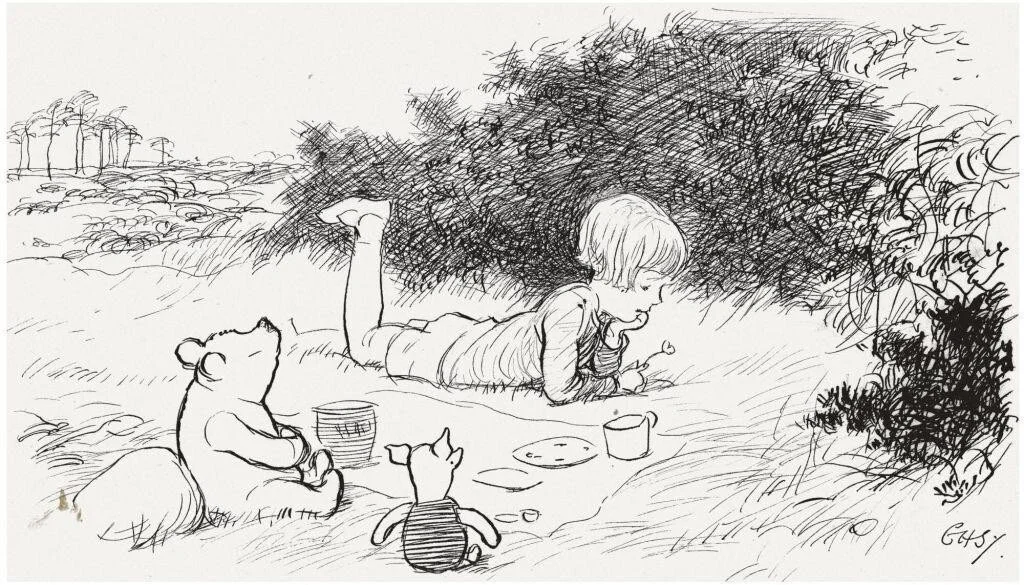
E.H. Shephard’s illustration of Christopher Robin, Pooh, and Piglet resting in the grass…
…And then there’s David and all my students, I’d like for them to be Christopher Robin is being allowed to just be. I give them stuffed animals, from toddlers beginning to play to teens needing something to hold…Sometimes when I see the E.H. Shephard’s illustration of Christopher Robin, lying on his stomach in the grass, next to his toys, simply holding a flower and world-building about Heffelumps, I think of my King David in all his sensitivities.
Pooh has been saturated in color whether in anniversary editions or cartoon films about him. It is said that babies only see black and white at first. David and I read the stories in color, but now when I read them as a middle age woman, I enjoy Shepard’s original black and white drawings breaking up Milne’s delicious tales with white spaces of meditative motions. That may be because that is my favorite type of art. And when I draw for my students, it’s always in black/white. And the children evolve it by adding their own colors. This reminds me of the end of the first book when Pooh is given a special gift. In the previous chapter he had recused Piglet:
When Pooh saw what it was, he nearly fell down, he was so pleased. It was a Special Pencil Case. There were pencils in it marked "B" for Bear, and pencils marked "HB" for Helping Bear, and pencils marked "BB" for Brave Bear. There was a knife for sharpening the pencils, and india-rubber for rubbing out anything which you had spelt wrong, and a ruler for ruling lines for the words to walk on, and inches marked on the ruler in case you wanted to know how many inches anything was, and Blue Pencils and Red Pencils and Green Pencils for saying special things in blue and red and green. And all these lovely things were in little pockets of their own in a Special Case which shut with a click when you clicked it. And they were all for Pooh….Later on, when they had all said "Good-bye" and "Thank-you" to Christopher Robin, Pooh and Piglet walked home thoughtfully together in the golden evening, and for a long time they were silent.
Helene Berr described Winnie the Pooh as “That halfway cheerful, serious tone that both laughs at children and stands before them in admiration, that understands that compared to us, children are infinitely superior. It was pure ecstasy for me.” Later in that journal, she echoed again of people not understanding it - “Afterward, Mother, who was a little sleepy, asked me, smiling, “And what happens to Winnie?” But I knew that if she was asking me the question, it was more because my enthusiasm had moved her than because she was interested in Winnie. I was the reason for her interest and not the book. Surely part of it was a desire to please me. And she was amused. But she didn’t understand the book the way that I would have liked her to.”
Obviously, so many, many children of any age never experienced Christopher Robin’s childhood. But nowadays, it doesn’t even seem possible. I feel something is very lost for children. If presented Winnie-the-Pooh to students now, whatever the school, I’m not sure they would understand either. I see so many don’t play with toys or go for walks in the woods. At my current school, it took me long to get them to even share art with me. I teach them to draw animals, they color all they can now.
Helene Berr did not survive the Holocaust. She was arrested March 8th 1944 at home with her parents. Then she was deported to Auschwitz and later transferred to the Bergen-Belsen concentration camp, where she died of typhus in April 1945—only five days before the camp's liberation. Her journal was saved and returned to her fiancé and surviving family. The book was finally published in France in January 2008 to global acclaim.
“I went to the Galignani bookstore. I didn’t find Winnie-the-Pooh but I did find Through the Looking Glass, the sequel to the story of Alice, and a book of children’s poems by the same author who wrote Winnie-the-Pooh, also beautifully illustrated.”
When I re-read that part of her diary recently, I too returned to Winnie-the-Pooh, hoping to communicate her across time and space. I said in a whisper, “I hear you, Helene. I understand.” And I picked up the second book she was looking for in Paris: The House at Pooh Corner. She never had the chance to read it I will read it for her to my students, hoping they experience some of the ecstasy that Helene Berr did, gentleness that Christopher Robin did.
