

In Your Reflection - The Tragedy of Hamlet
I remember a student once said to me, “If you could time travel anywhere, Ms. Grippo, what would you like to see?”
”I’d like to be at the Globe, watching Hamlet for the first time -”
”What part?”
”To Be and Not to Be, of course. You?”
”I’d like to see Will Shakespeare as the ghost!”
I was walking away from the theatre with that memory, after just seeing the incredible new film Hamnet, an imaging of Shakespeare’s family in Stratford Upon Avon, and the perhaps essential experiences that birthed his greatest work.
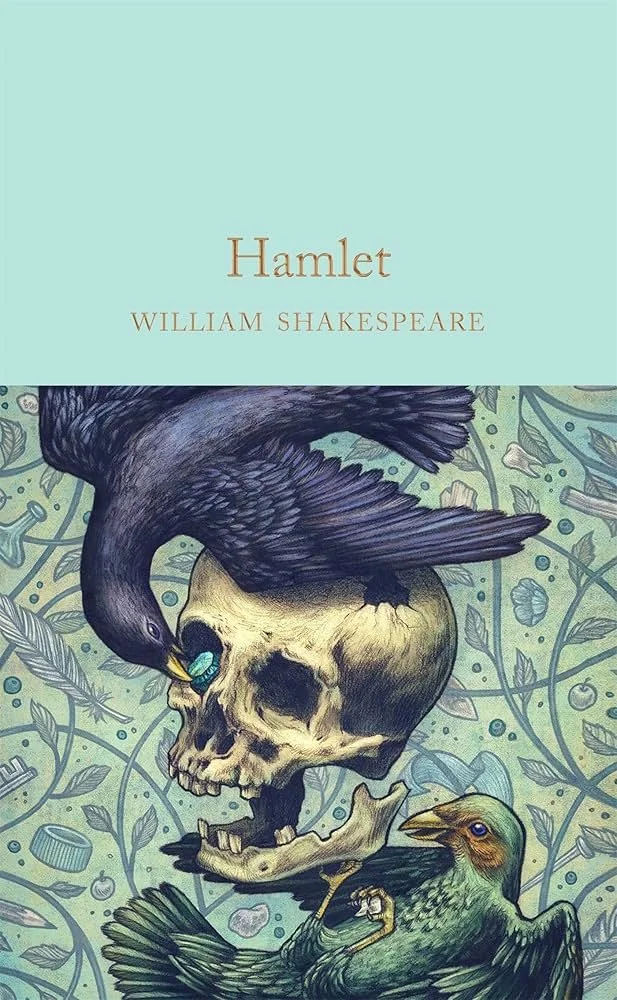
The Tragedy of Hamlet, however is a very different setting - a play about the Prince of Denmark, who after the death of his father and the loss of his crown, is met by a ghost. The ghost claims to be his father’s spirit and reveals that he was murdered by Hamlet’s uncle (who has quickly married Hamlet’s widowed mother and seized the throne). The ghost urges Young Hamlet to avenge him. Hamlet takes some time, pretending to be mad as he thinks through language through big decisions and actions that may shatter the prison of his consciousness and kingdom.
I go to sit outside a closed bookstore, thinking of one of the first lines of the play, “Say, What, is Horatio there?” (Hamlet Act 1 Scene 1)
I almost expect my former students to call out the next line, “A piece of him!” Of course, none of them are with me. I almost cry.
I wish the bookstore was open this Thanksgiving night, so I could go in to the Drama or Classic section. It’s been a whole year since I’ve sat down to read an entire Shakespeare play, a whole year since I’ve stopped teaching it. Now that I’ve opened his world again, I can only go one Act at a time before I write this reflection.
If I read more all at once, I’ll get lost in the woods. And yet, it is essential to get lost in the woods with Will. You go to change. Some say a comedy means the change is reversible, the disruption mendable, the problem solvable. In a tragedy it’s not. Or as my students in my Shakespeare classes would tell me, “In his comedy everyone gets married. In his tragedies, everyone dies.” I smile, knowing it’s not that simple as any of that, but I’ll let them figure it out…
And they will figure it out even without me. When I moved from Carolina to Florida, from one school to another, I had to leave them. They had to go on without me. As I watched a movie scene were Shakespeare and family find their dead bird, I come to think of the lines of his play at are not stated, but there in spirit.
“There’s a special providence in the fall of a sparrow. If it be now, 'tis not to come: if it be not to come, it will be now: if it be not now, yet it will come: the readiness is all.”
(Hamlet, Act 5 Scene 2)
Were my children ready to be without me?
While, in my college days, I dabbled in teaching a little bit of Shakespeare as a professor’s assistant for young adults, I always dreamed of teaching it to kids.
Why?
Well, my childhood was magic with imagination and tragic with sensation after the death of my father. It’s a story of many undiscovered countries and journeys end in lovers meeting all in one. I remember often feeling sometimes trapped and sometimes transformative in my world as a child, but I had no way to express myself. I also believed no one felt like this ever before. Then I was given the play The Tragedy of Hamlet. I was so in love with being wrong upon the first reading.
The characters thought everything I could and couldn’t imagine. Each time I read the play, it was in a new voice too (for Shakespeare never used brackets, you can always act a new way). Shortly after reading Hamlet I saw an Ingmar Bergman film called Fanny and Alexander which explored the world of theatre and the spinning nature of everything being a death-like dream through the eyes of a child who tells fantastic stories yet also observes horrific happenings in silence. Hamlet is a symbol in that film that the child needs and has. I realized I had been poor as child because I did not have Shakespeare. I knew he would’ve have been my water and light and reflection and all I could not word. I wanted other children to have all that.
When I came to work at an Arts and Science school in South Carolina for what would be 6 years, I took on the 10 year olds through 14 year olds. We had many, many classes together, but Shakespeare was always the favorite every day. We even had a game where we tossed around a plague doctor stuffed animal called Bill, stating Shakespeare Is… as quickly as they could every time another student caught it.
“Shakespeare is dead.”
“Shakespeare is father of 3 children.”
”Shakespeare is the husband of Anne Hathaway”
“Shakespeare is the author of around 38 plays.”
“Shakespeare is the first one to play the Ghost in Hamlet.”
”Shakespeare is your reflection”
My goal was to get them to love the bard. There’s a story told by Maya Angelou that she discovered Shakespeare in her own girlhood. She was thrilled that an author understood all she was feeling, and imagined Will as a young black girl like herself. I was hoping my children would have similar experience.
The children came to understand there was no correct way to take on Shakespeare. Sometimes he was our center of Drama class when we put on short versions of his plays. Sometimes of Literature when we read his works adapted as graphic novels. Sometimes of Writing when we tried our own archaic language as well as sonnets. Sometimes of even Science when we got to his inner knowing of the universe:
“So you see,” I told them, “instead of being in one state, a quantum system exists a ‘superposition’ of all its possible states at the same time.”
One boy grabbed his foam sword, swishing it in the air.
“What are you up to Horatio?” I asked, which I did whenever he grabbed the sword.
“Hamlet says To be or not to be. I say it’s to be AND not to be at the same time!”
He runs it through me. I fall and play dying. Then laugh as I begin to get up.
“I don’t get it, Ms. Grippo!” says a girl, who takes another sword and stabs me again so I stay down, “Why do characters in Shakespeare’s tragedies get up and dance at the end?” She is referring to the plays we’ve watched on screen or stage where the players get up and celebrate after the curtain call, “Hamlet said…”
“….The rest is silence,” the boy finishes and shrugs his shoulders, “Whatever.”
I try to answer them in a dying voice, “I guess there is no such thing as still fact…it’s nothing but change since the universe began,” I tell my students.
The boy raises his sword, “The more we learn about the universe, the more there is to find out.”
“Yes. You see, Quantum Mechanics runs our world, and yet we barely understand it. Perhaps another generation will.”
The girl responds, “But what won’t they know?”
When my students and I discussed Hamlet as a character we wondered if the narcissistic and/or thoughtful Prince was too sensitive for his time. One little boy shouted this out, “sorry, Hamlet, you’re too ahead for everyone else!” Hamlet’s question and perhaps answer ushered in a modern sensibility unlike the feudal ways of his father. The split between those times was not still reality, but a state of becoming because of Hamlet’s words…
I walk along the bookshop window, seeing if I can read any of the titles inside. I think of my students jotting down their notes for each lesson I had to put on the whiteboard. They especially like to pretend they were like Hamlet and Horatio at school in Wittenberg. I remember one little boy on his aced vocabulary test and even putting three extra terms at the end: “Words. Words. Words.” (Hamlet Act 2 Scene 2).
Sometimes I hear people talk about how “words” have emptiness and translucency, even Shakespeare, but he never made it a goal of ridding ourselves of language…
I remember my children and I reading many accounts of people with paralysis or a hearing impairment or autism finding their voice through words. Though they had gone far beyond Will’s quill to a typewriter or sign language or AAC. And we learned that despite the mainstream emphasis on movement and action, many people who have been experienced the silence, would rather talk than walk.
Now because I study disability culture with my children and am disabled myself, I know, know, know that language is not only a reflection, but a freedom from prison. My students knew of Helen Keller, deeply admired her activism (though didn’t care for her opinions on the Shakespeare authorship argument - my kids will indeed go to their graves believing Shakespeare was, in fact, Shakespeare!). She described herself as a phantom before language came to her at the water pump and for the rest of her life. So many humans suffer because they don’t have access to language. Imagine being trapped in your body and unable to tell anyone anything. When this happens to a person, it is half prejudice’s fault (lack accessible language tools for the disabled) and half nature’s fault (mutations that shape the disabled). Again, most disabled people I’ve talked to said they may rather have talking than walking.
I know words can speak louder than actions…even in Hamlet’s case. Imagine if everyone else stopped to think and consider in that play. Imagine if they talked to themselves. Would all the tragedy in the play be avoided? I don’t know if language does reduce existence to position, but if it does, on the other side of the coin, it sets people free to new realizations and possibilities. It gives the sensitive prince of a bloodthirsty king a chance…
If I called my Yeshiva students “Horatio” they’d stare blankly. I don’t teach Shakespeare at my new school and probably never will. We have our own nicknames. The yeshiva students call me “Morah” for teacher, or more often “Ima” for mommy. It warms me. But also reminds me…
Even my former students gave Gertrude far more credit than Hamlet did. He seemed to have only trust, maybe not even in his the ghost of his father, but in his friend Horatio (and the memory of his jester, Yorick). My Shakespeare students wondered if she could in fact be trusted more than Hamlet thought…she may have took her deciding vote of who became king by marrying Claudius so he wouldn’t kill Young Hamlet. And though in my blogs, I try not to spoil even the most famous of classics, but maybe even her last lines and act are on purpose for Young Hamlet.
I didn’t share Shakespeare with my former students simply because I loved him, but more so, because I loved them. I wanted them to know that someone felt their pain, joy, confusion, romance, wonder, horror, and everything else. They weren’t alone. They always have a book to turn to or a character to interpret without brackets. They would say, “To be or not to be” in completely different ways from one another. Sometimes people would worry Shakespeare was too dangerous for the young. To which one boy, hovered over my the thick collection of Will’s words, would say without looking up, “Shut up, this is good for us.” I wasn’t sure myself, but we often discussed that these plays were not calls to decisive action, but to emphatic imagination.
“Who is the bad guy? It’s confusing” one student asked when he was auditioning out his character for our little acts.
“Well, I’m glad you picked that up. it’s not really about Hamlet vs his Uncle like we’d think…or against his mother or the ghost or Elsinore…who is Hamlet versing most…”
“Himself…” one girl smiles.
“Yeah!” a boy echoes. “These are crazy things happening…his dad died, his mom married his uncle, his girlfriend lost her mind, he’s being spied on. This is one crazy family Thanksgiving!”
I can’t help but laugh, and then grow serious. “Shakespeare is not telling you what to do. He was everybody and nobody. We don’t know his opinions. If he told you what to do in a play, he probably be killed for it at some point.” The kids loved hearing stories about the dangerous times Will lived in, and wonder with giddy horror how he stayed alive against the disease and accidents and ways of execution.
I look back at the theatre where I saw Hamnet. It was a powerful film, not only about the writer or his son Hamnet Shakespeare, but greatly about the women in his life, especially his wife. He was a man of words, but she had the action Hamlet so longed for. Again, I won’t spoil the beautiful film anymore than I would the play. But I recall my talks with my children on Ophelia…
“She does something bad,” says one girl, “She commits suicide.”
”There is a willow grows askant the brook,
That shows his hoar leaves in the glassy stream.
Therewith fantastic garlands did she make
Of crowflowers, nettles, daisies, and long purples
That liberal shepherds give a grosser name,
But our cold maids do dead-men’s-fingers call them.
There on the pendent boughs her crownet weeds
Clambering to hang, an envious sliver broke,
When down her weedy trophies and herself
Fell in the weeping brook. Her clothes spread wide,
And mermaid-like awhile they bore her up;
Which time she chanted snatches of old tunes,
As one incapable of her own distress,
Or like a creature native and indued
Unto that element. But long it could not be
Till that her garments, heavy with their drink,
Pulled the poor wretch from her melodious lay
To muddy death.”
(Hamlet Act 4 Scene 7)
I sigh, knowing this conversation was coming, “Hers was permanent response to a temporary problem. That’s what suicide always is, my Horatio’s. But in the play, just use your imagination…you can be moral, immoral, or amoral for the four hours that Hamlet runs…”
One boy thinks aloud, “Do you wonder if Prince Hamlet wanted to be like Ophelia?”
“Frailty! Thy name is woman!” I misquote for Ophelia instead of Gertrude.
But the kids misquote back that Hamlet “doth protest too much.”
I continue, “And lose all his freedom? Oh wait…maybe they were alike. Both were trapped…both had method to their madness. Remember when Ophelia gives the flowers? They all represent something, and she’s tells the people she hands them to what they’re guilty of. She also does what Hamlet says he wants to do. Maybe…”
As the memory fades, I realize I must turn away from the theatre and the bookstore. I must go home to prepare for my yeshiva students, but how I wish I could’ve shared this holiday night with my former Shakespeareans. What would they have said at this scene or that scene? I tried to give a little gasp or hum whenever a line from Hamlet was directly or indirectly revealed. I looked to my side as if to watch invisible theatre goers, but my children, past or present, were not there.
There were two scenes that haunt me.
I cried when I saw the quiet Will readying himself to play the ghost, as my children had often wished they could see.
Another scene is where the boy Hamnet is heartbroken to realize his father is going to London without him and his family. His father asks him if he will be brave and look after his mother and sisters. I remember the day I told my students I would be leaving to go work at a yeshiva. It was a day of hugs and tears, anger and worries, acceptance and silence. And words. Words. Words. One student falls down, pretending to be dead and I quote to him,
” As thou ’rt a man,
Give me the cup. Let go! By heaven, I’ll ha ’t.
O God, Horatio, what a wounded name,
Things standing thus unknown, shall I leave behind
me!
If thou didst ever hold me in thy heart,
Absent thee from felicity awhile
And in this harsh world draw thy breath in pain
To tell my story.”
(Hamlet Act 5 scene 2)
He reaches his hand to me and I pull him up.
It was one of my hardest days when I said goodbye to them, but like Hamlet, I hope they “remember me” and, as I told them on my last day, “be as thoughtful as Shakespeare’s heroes and as brave as his heroines.” And, yes, I know those students are thoughtful and, indeed, brave.
