

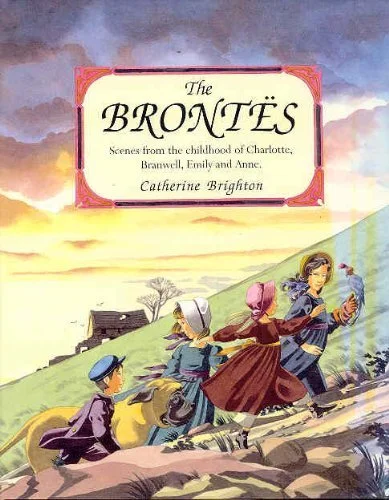
Making Alive - The Brontës: Scenes from the childhood of Charlotte, Branwell, Emily and Anne
“Oh, Morah!” my students cry to me, “I have absolutely nothing to write about!”
So begins every writing class in my past 20 years as an educator. And so I still ask myself as every student is so different…how can I show - not tell - that they do have something to write about? That the beauties and truths inside and beyond each of them are things to write about! Things they’ve experienced or the things they never experienced. Also the imagination that binds the two things together is something to write about!
You know, the Brontë sisters usually enter any reader’s life during our teenage years. Yet their childhoods were utterly fascinating and something I’d like to share with my students one day.
I’m currently learning to find a way in an elementary school, in childhood - a time far too young for the Brontë novels.
Though they may…they just may understand the first part of Jane Eyre - a novel that realizes the pain and injustice children often go through, and the bravery one needs to come of age internally and liberate personally in such experiences. Charlotte was groundbreaking with such a work. And speaking of Charlotte…she is the imagined narrator that I have just come across a beautiful picture book called The Brontës: Scenes from the childhood of Charlotte, Branwell, Emily, and Anne written and illustrated by Catherine Brighton.
While very common these days to write storybooks about historical figures, I don’t know how long it’s been a tradition. This take is from 1994 before I even knew of the Brontës and before I could read myself! It’s a wonderful binding that is colorfully tender and eerily beautiful, narrated by Brighton’s idea of young Charlotte as she and her siblings explore the sublime moors about their home and create fantastical worlds in their isolated youth.
I currently working at a Yeshiva - a religious school for Jewish children. In a way, my students remind me of the Brontë siblings - they are not around the diversity that encompasses many other schools and so experience a very certain type of world which, yes, can be isolating or misunderstanding…and yet also where they can also find freedom to be themselves which is very rare in our world. In other ways, my kids are, thank goodness, absolutely different from the lives that Charlotte, Branwell, Emily, and Anne lived. Unlike the school they went to, mine is a loving place to where I feel the kids are encouraged and nurtured. Not to mention without the common distractions and destructions of social media and tablets. We use pen and paper and play which gives them a chance to explore themselves when bored, to be creative when in pain, to fill their experiences and lack there of with imagination!
I haven’t fully immersed myself in the Brontë Sisters world since my teen years. I always keep meaning to come back though. Before I moved to my current school at the beginning of this year, I was a middle school teacher for half a decade, and was planning on reading to my then own tween and teen students scenes from Jane Eyre (and I would have encouraged the oldest of them to discover Wuthering Heights on their own). Emily and Charlotte certainly influenced the person I was growing up to be. Why shouldn’t my students have such a privilege? Without even thinking of it, those two writers are still influencing me. Unlike so many other books, even just one reading of either hasn’t ever stopped haunting me.
This is important: I’m sorry I can’t say the same for Anne as I’ve never read her before. I hope to change that one day. From what I hear from others, she deserves a deep read! Yes, from what I hear, she’s brilliant and powerful in her own way.
So if I haven't read those two famous novels in a while, what am I gonna write about?
Not exactly the entire series of spiritual movements that this picture book gave me. You see, each picture opens another window, and I’d be analyzing for pages and pages. I want to talk about a particular line that struck me. And then I will focus a little about how the sisters lived their lives, childhood and beyond.
Once, their brother received a gift of toy soldiers from their father. He and girls played with them for hours every day - giving historical names, acting out dramatic scenarios, and just enriching in their magical worlds.
The storybook goes: “Sometimes our battles last all day, and everyone is dead by the evening. We have invented a rule called making alive so the game can continue the next day.”
If you have the privilege, as I do, to express and advocate for yourself, try to imagine the opposite for a moment. Try to imagine you’re not free.
*You can be be murdered by an institution like school or religion
*You can be locked away on a more powerful person’s whim
*You’re not allowed to express your instincts, your wisdoms, your passions
*You’re not allowed to enjoy any role you find yourself in
*You have no right to make choices about what you’ll do with yourself
*And you’re not allowed to claim the efforts of your own imagination
I’m not talking dystopian futures. This was the past for many women in the time of a Brontë sisters. And, horrifically, if you go around the world to too many places, it's the present for far more women than someone as privileged as myself can often realize. Every day I thank goodness that my children are free to learn and be what they want! And every fews days I’m a little bitter when they don’t realize it and complain about their freedom. But I am no different. I can take many liberties for granted. We all can.
Anyway, I’m not here to give a critique on Victorian society or my society or any society. What I want…is to draw attention to these women’s efforts to keep on keeping on…despite all they endured. To always be…making alive themselves from their tragedies. Throughout their short lives, they turn the terrors that circumstance and chance inflicted on them into something creative.
I’ve read of their lives in other books before. It often starts with the death of their mother and follows the sisters throughout their few years. Lives that were overwhelmed with sorrow because of more death and of society’s repression. The girls were sent to a dangerous school that abused them, and ended up, indirectly, killing two other sisters. Fortunately, Charlotte, Emily, and Anne escape that ending, but not without trauma.
Despite losing people, or maybe because, the sisters become very close and they have an urge to express themselves. From early childhood, they build entire worlds to escape to together. Places they call Gondal and Angria. These are complex fantasies with so much activity - people falling in love, people having battles, people making kingdoms!
I really was reminded how far a child’s imagination can go - must go! - when life is so unfair. However, unlike many people who grow up and grow out, the sisters don’t forget these ways, especially Emily. They keep returning them throughout their lives.
There’s something else too. The girls’ father had some common sense, and gave his daughters access to books! Real books! They devoured Shakespeare, of course. But also Romantics like Wordsworth and Lord Byron - poets that ignited their minds and hearts in Nature. Nature became their friend. Again, particularly Emily’s…it becomes perhaps more than a friend to her!
As I read the storybook, I imagined the tall, quiet Emily being able to sense what others couldn’t about the universe. I could see her on the moors with only her dog, exploring and embracing the outside. There’s a beautiful scene on one page of her clasping up to the lightening and darkness, giving passion to the earth.
The book I just read doesn’t talk about the dark school days of past or of the tragedies to come, but explores many simple and gorgeous moments of their childhood when in the safety of Nature and Home. And the book ends in an evocative way on a bright winter evening with the girls dreaming to become real writers one day…
Still, from what I’ve read in other biographical sketches, as they grow into adulthood, they soon realize there may be nothing they can count on. Their father, though loving, will one day be gone. Their beloved brother has become lost to them through alcoholism and opium addiction. There’s not really any possible marriage prospects. No jobs available except to be a teacher or governess - which, in Victorian England, could be a miserable profession.
So they try to share their writing…they start with publishing poems under secret identities, because not only was a Victorian woman shunned for writing, many topics were forbidden to her, particular passion.
Still, these women continue to turn their restrictions into something alive and deep. They each end up writing and publishing at least one novel. I’d love to say that their world-changing books would change everything for them too, and that they lived happily ever after, but their lives do not end in triumph. Because, as we all know, and as they know too well, these close sisters will have to lose one another sooner or later. Sooner in their cases.
And yet, again, what strikes me about their life story is the act of making alive. All of them keep boxing on! That is, they keep writing, keep striving to illuminate themselves within and beyond illness and heartbreak.
It’s not easy because each of their uniqueness was unable to function in society. That’s a good thing, but a deeply painful thing nonetheless. I wonder if my children will ever feel that. As for the Brontë’s: instead of conforming to society or of waiting for a rescue, they make something new to say about the worlds they inhabit. At least it feels new to everyone else, because what they write disturbs and inspires people. I remember once reading in depth about critics and audiences aghast reactions to the novels. I enjoyed watching such shock unfold.
When I was a teen, I was often trying to process those strange, wonderful books. How does a kid not fall under the hope of love and the envelopment of passion? How do they not fail to understand Heathcliff as a monster, Rochester as a jailer? Those slow realizations broke and strengthened me. I learned how to let myself to feel Cathy’s sense of torment or Jane’s sense of injustice. As well as my admiration for them which I don’t know how to explain. I won’t delve into these things now, because I won’t do them rightful representation at this moment. I’m just saying all that to let you know, I haven’t forgotten that I was touched deeply.
Now all 3 of the Brontë sisters have a bravery in their intuition and sharing of the fierce humanity through their incredible language. Still, again, I can’t help but wonder mostly about Emily…
It seems, at least as biographies show, that Charlotte and Anne’s stories come, not all, but a lot from their own experiences. Whereas Emily’s comes entirely from her own imagination.
Again, I haven’t read the Brontës for almost 20 years, but they haunt me much like Cathy haunts people in her novel 20 years on.
From what I remember about Wuthering Heights, the author has such an inner knowing for extremes she didn’t herself go through, at least I hope not! I would never ever cheer for people like Heathcliff and Cathy, and Emily’s poetic heart is not sentimental or lowercase romantic. She shows what cycles of abuse can do, what terror they can create! I know she wrote mostly for herself, but I’m so glad such a horrific and magnificent book was released.
It’s from her that I dare to think of monsters destroying each other. I dare to think of being in love and, furthermore, bonded to Nature. And I dare to think of being creative even when you know you’re gonna suffer and die.
And, like many people who misunderstand or even hate Wuthering Heights would do, I also wonder where is there the hope? Or is there any?
Maybe looking for hope is not the right thing to be doing when it comes to any of their words. I don’t think making alive means that at all.
Maybe it means to open the window to a haunting, to a truth, to a beauty…that we can no longer pretend is not there.
I hope one day my students stop pretending they have nothing to write about. As I had to do.
Maybe they can just wrap their arms around the ghosts they see, take them in, and then be brave enough to keep on boxing on and writing on to tell their own story…
