

Gender Fluidity in Judaism - My Guardian Angel
“Rachel and Naomi sat on either side of Elvina. They seemed troubled and gloomy, and for once they were silent. Rachel was staring obstinately at her feet and swinging them to and fro. Naomi was frowning. Their spindles and staffs lay abandoned on a bench.
Naomi spoke first, ‘They’re making him lick the sacred letters, aren’t they, Elvina?’
‘Yes,’ Elvina began, ‘First they give him the honey cakes, then the apple and the egg—‘
‘Yes, yes,’ they interrupted. ‘We know that already, but what happens next?’
‘Then Obadiah gives him a wax tablet with the sacred letters on it. He spells them for Toby, one by one, pointing them out with his finger.’
‘And then?’
‘Then Obadiah spreads honey on all the letters and Toby licks it off so that they will test the sweetness of the Torah. Then they all gather around Toby and congratulate him and dance around him. Of course, Obadiah’s pupils love this extra break time, and they try to make it last as long as possible.’
Without doing it on purpose, at least not absolutely on purpose, Elvina had mentioned Obadiah’s name no few than three times. Surely the twins were going to jump at the chance to tease her mercilessly! Elvina prepared herself for the onslaught, but none came. There was silence. It was as if the twins had become not only mute, but deaf as well. Rachel continued rocking back and for on the bench, shining her feet as high as she could, and Naomi continued to frown and state into space
‘And what about us?’ Asked Rachel, finally. ‘Why don’t we get all that? Why don’t they let us lick the sacred letters? They don’t even show them to us. Why? Elvina? Why?” She was on the verge of tears.
- pages 132-133 of
Sylvie Weil’s My Guardian Angel
I went to a synagogue today. It was my first time in months.
I am a Jew.
I have a lot of identities, but that is probably the one I most enjoy and most part of myself that I need to share. Being a Jewish woman, I love to read! My whole room is covered in more books than it can hold. I like to read all kinds of things, but I do get excited when I get a book with Judaism at the heart comes to my hands and eyes.
Yes, representation matters, and it’s special when you find you’re not alone. Whether it be a historical document or a work of art or both in one. That brings me today’s a book.
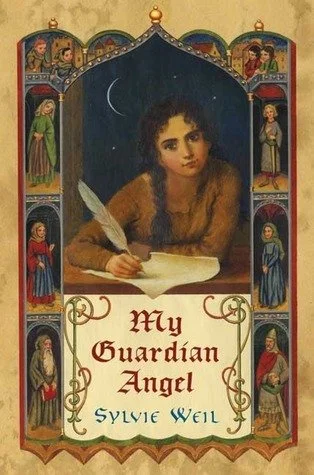
A children’s novel called My Guardian Angel by Sylvie Weil.
Oh, and, yes, that author IS the niece of French philosopher and activist Simone Weil, which is another fascinating story, I’m sure.
At the time of writing, the high holidays of the Jewish year 5786 have not too long ago passed. We have celebrated Rosh Hashanah (the new year), Yom Kippur (a time of repentance and forgiveness), Sukkot (a time of building huts outside our house for thankfulness), and Simchat Torah (when we dance upon completing the cycle of reading the whole Torah and begin it again…again). Lots of beautiful traditions and stories to experience.
But this year, I was very quiet for the holidays. This was my first year in my new life of teaching at a Yeshiva as well in a new home of my own. Maybe it was all so good to be true that I felt a bit overwhelmed.
Because the years before were different…I remember…
As they opened their schoolbooks to reveal the candy I had hidden inside, the students whispered gasps of thanks. “Learning is sweet,” I reminded them. I think of those former students, knowing nothing of these traditions, raising their hands to ask questions about Simchat Torah…. “you get to dance with a giant book…?” asked one boy. He then added, “that’s so cool!”
“You guys have the best holidays!” called out one of my girls.
And they all really believed that.
Though not Jewish, the children had celebrated many of our holidays with me (in our own way). I never told them about my own beliefs. Judaism is a religion, yes, but also a culture, a nation, and a people. We kept it about culture entangled with the stories that no one could prove or disprove. I encouraged my students to love their parts of their own identities too, which in part was Christian or Atheist.
Yet we learned all kinds of things. We shared with each other as we studied everything together. We learned Math that could take us to the Moon, Science that revealed the wonders of evolution, History that showed how complicated humans are, and Language which was our favorite - filled with my own stories and their own writings.
Of course, though, they looked forward to the days where we could take a half an hour off to celebrate a Jewish holiday. That was always their favorite, as they told me every year. I couldn’t keep up with every celebration of my people’s calendar, but we tried as many as we could.
Rosh Hashanah - we shared my homemade challah. As well as apples and honey. I taught each child how to blow a shofar.
Yom Kippur - we didn’t eat for break that time, but we made apologies to one another and happy plans for better times ahead.
Sukkot - we build our own temporary home out of package boxes and crayons drawn leaves. The children read their books inside that home.
Simchat Torah - we each picked our favorite books and danced in circles around the room while carrying them.
In those years, on weekend mornings or on special nights, after my students were off to their homes, I knew my old temple was celebrating, so I picked myself up quickly and drove an hour to it. Being at a conservative (traditional, but egalitarian) shul then, I put on a tallit and kippah (prayer shawl and head covering) which was accepted and even encouraged though usually worn by men. I stood, I rocked, I prayed. Then the Rebbetzin - came and whispered if I could bless the Torah.
My heart shined and shook at the same time. I was frightened that I couldn’t read the Hebrew well enough, or I’d mess up. Still, I very much wanted to try. I wanted to read and say the Hebrew prayer that would sanctify the moment. Maybe it’s because I’m a Jew, I don’t know, but I love words. Torah or not, words are sacred. They are just like light.
The Rebbetzin encouraged me and we whispered a practice blessing together. I went up among the Rabbi and the other people helping him hold this enormous illuminated scroll. They all smiled at me and whispered kindness. I got to kiss the sacred words with my tallit, I got to read sacred blessings in Hebrew with my Siddur, and, most of all, I got to stand with my people - each of us a sacred life.
These are interesting memories pondered in my heart. And I have so many Jewish books pondering in my library, but today I picked My Guardian Angel because the main character shared my love of words.
This is the story of Rashi’s granddaughter, Elvina.
Rashi was one of Judaism’s greatest teachers. His commentary on Torah was and is still used in most Chumash (the 5 books of Moses), and he’s one of the reasons Talmud (a collection of debates over law and legend) is alive and well. He lived in the 1000s, mostly in Troyes, France. He opened his own school there. He’s a fascinating person, I urge you to look him up, but this book is about his granddaughter.
See, Rashi had no sons, so he taught his 3 daughters to read, write, and study Talmud. While that is not forbidden, it was once seriously looked down upon to the point of emotional suffering (anyone who has seen Yentl knows what I’m talking about!). Now times are different. Not just for Conservative or Reform, but for the Orthodox too.
Rashi’s granddaughter, Elvina, was, in fact, a learned woman and inspiration to her people. This novel is an imagining of part of her youth.
We start when she’s 12, nearly 13, and she can sense, almost painfully, how unusual she is. She loves to write. This book is her imagined writing. It’s weaved like braided bread with its narration. It’s partly Elvina talking to herself in the 1st person. Partly a 3rd person narrator watching her every move. And then, most touchingly, a 2nd person narration - Elvina talking to us as her Mazal (her guardian angel).
Now she says at the beginning that her grandfather, Rashi, taught her something very special:
“My grandfather says that all men have a Mazal: a celestial guide, a guardian angel who speaks up for them in heaven. That is what distinguishes men from animals, who, poor things, have none.
I once asked my grandfather if a girl could have a Mazal, too. At first he laughed and pinched my cheek as he always does, saying that girls don’t really need the help of guardian angels, as they have no trouble speaking for themselves! But then he grew serious and said that ever single human being has one.
This means that even though there is nothing special about me, apart from being the granddaughter of the great teacher Solomon ben Isaac, I Elvina, age twelve (nearly thirteen), have a Mazal of my own.”
- page 1 of Sylvie Weil’s My Guardian Angel
So Elvina talks to her angel throughout the book for all her emotions and trials. Sometimes we read what she thinks the angel is saying back.
I think it’s interesting that this angel, in her perspective, is very challenging. Not just a comfort or reassurance, but someone who questions her ideas and urges to do what must be done. That might be different than what many people who imagine angels are used to, but think of it from a Jewish perspective. The name Israel itself means, “one who struggles with God and prevails”. Yeah, our angels do challenge us, wrestle with us. And Elvina is up for that challenge.
The story takes place during the Crusades. Peter the Hermit is coming through their town with his men. And the Jews fear for this lives. This is way before the state of Israel, of course. So we’re not able to fight back. That doesn’t mean the Jews of any time didn’t resist brutal murder or forced conversion. They did in various ways as this book shows, but you can feel the tension throughout the story of how dangerous it is to be a Jew.
As you read, you kind of see Elvina as a Queen Esther reflection. Not only does the story take place during Purim (the holiday that celebrates her and the hiddenness of God). She is constantly crossing between two worlds to help in such a dangerous time. She goes back and forth between the men and women to take care of her loved ones. She goes back and forth between the Jewish and Christian citizens to save her people. These things are not easy at any time in History.
Let me relate a little.
There’s a scene in the book where Elivina, who, skilled with herbs and remedies, goes to heal a Christian friend. Though they shower her with hugs and kisses, they also bully her, nearly demanding her to become a Christian - to give up her books and be baptized. I know this feeling. My Jewish friends know this feeling. It’s awful. I am often asked to become a Christian, and when I refuse it bothers some people.
Sometimes it’s a humorous exchange, but sometimes it’s a dangerous one. Even in the book, there’s a kidnapping scene of two Jewish boys who are threatened to be baptized, taken from everything they’ve ever known, and forced into the Crusades. Yeah, Jewish children were stolen. But Elvina represents her people well here. She and all us Jews are not supposed to want others to be like us, but we do hurt when others try to make us into something we’re not. Perhaps anyone who’s been bullied for their identity can relate to that. And maybe it could be an eye-opener to people on a quest to change others.
It’s not all beautiful and untouched by prejudice in her Jewish community though! The men and women are separate in many ways. Let me clear - that can be beautiful too if that is a personal choice and if it’s firmly different, not less…but, in this story, they’re expected to have different roles. And if you don’t, you are looked down upon severely. Not everyone is Rashi, who is very kind and aware in the book. He admires his granddaughter the way she is.
Now, let me be clear, she isn’t really a stereotypical rebel that showers many books without careful thought today. She is considered a gentle girl. She’s respectful to all her family members, she can run a house when her mother is gone, she keeps Shabbat very holy in what’s considered a feminine way. But everyone also knows she is unusual. Not only because she loves to study and write, but she speaks her mind, she’s extremely generous, and she takes big risks. In my opinion these can be the quality of any gender, but, certainly not in the story’s point of view. So I love how the author blurs the lines of what she is. Perhaps her spirit in non-binary in a way.
I relate to this because I too find struggle in what mitzvah applies to me as a woman. And I too have found rebuke in the Jewish community. Not at my past temple nor now at my beloved yeshiva, but elsewhere.
I got tons and tons of comments bashing me in one way or another. I kept my peace, saying, there’s all different kinds of Jews. You practice your way, and I’ll practice mine. That didn’t help and they kept at it.
Still, I am fortunate. I have my own guardian angel…my teacher and friend, Yossi, who is one of the most devout Jews I know, and he told me not to pay attention to those comments. He encouraged to find my own intimate language with what’s holy.
I recall a different holiday and text: Shavuot and Ruth during this time. That is the day of the Torah receiving and book of converts. She was perhaps the most famous of Jewish converts. She is remembered for saying, “whither you go, I will go, wherever you lodge, I will lodge, your people will be my people, and your God will be my God.”
And she was the great-grandmother of King David!
Converts are people who chose to be Jewish. Sometimes they too blur the lines, not in the least cause they’re not always accepted. They might have a considered strange backstory or tradition of belief. That doesn’t mean, they’re any less genuine. Like Ruth, they are serious, and don’t go to leave when you offer them a way out.
I don’t normally share this beyond my dearest friends, but I’m a convert myself. I have Jewish ancestors on my mother’s side, but I was raised as a Christian. By the age of 12, I began to depart away from that head toward Judaism. I studied for years on my own and then with my past Rabbi, and eventually went through the official process to become a member of the tribe. Some people still don’t recognize me, but, like Elvina, I do find some kindred spirits. I have a close group of people I met in Israel, I have my loving teacher, Yossi, who I want to bring up again…
The holiday - Shavuot - that I just mentioned is, as I said, about what we received Torah at Mount Sinai. There’s a legend that all Jews, past and present and future, were at Sinai to accept that journey. I asked him if I, as a convert, was there too. He wrote to me, “Yes, you stood with the Jewish people at Sinai, in Auschwitz, and in Jerusalem. That's what you signed up for.”
And today I stand too.
Today, I remember that. I went to the new synagogue. I was determined to sit quietly on one side and take in all the beauty. But then an older man approached me and asked if I would open up the ark for the Torah to be taken out. I felt the sacredness speak to me. I put on my kippah and tallit, walked past both men and women encouraging a person of fluid identities, and stood before the ark. I waited till the cantor sang the prayers, and then I pulled the heavy doors and veils aside.
There was the Torah - written from the Writer of writers. I reached out with my tallit to touch the scroll to touch and then kissed my tallit.
What would Rashi and his granddaughter Elvina had thought?
Let me leave you with an conclusion excerpt the book’s scene which describes Elvina and other younger twin girls witnessing a little boy’s initiation into the learning of Judaism, breaking the twins’ hearts for not being able to experience the sweetness of the Torah themselves...
“Then, at the very same moment, the twins whispered to Elvina, one in each ear so nobody else could hear: ‘Show us the letters! Teach us to read!’ They begged. They moved closer, and once they had started, there was no stopping them. They threw their arms around Elvinia, stroked her hair, and competed with each other to see who could hug her the hardest. “Please, Elvina!’ They begged.
‘Ouch, you’re suffocating me!’ Their warm mouths remind glued to her ears.
‘Say you will, Elvina; say you will teach us!’ They whispered over and over.
Elvina close her eyes, and a smile crept across her lips.
‘Well?’ Asked the twins.
‘Well, Solomon been Isaac, my grandfather; says that there nothing in our Law that forbids educating girls.;
‘Are you saying yes?’ They asked, looking at Elvina expectantly.
‘Yes!’
The twins were overjoyed. ‘Can we begin today?’ They urged.
‘Yes, we’ll begin today,’ replied Elvina.”
pages 133-134 of
Sylvie Weil’s My Guardian Angel
